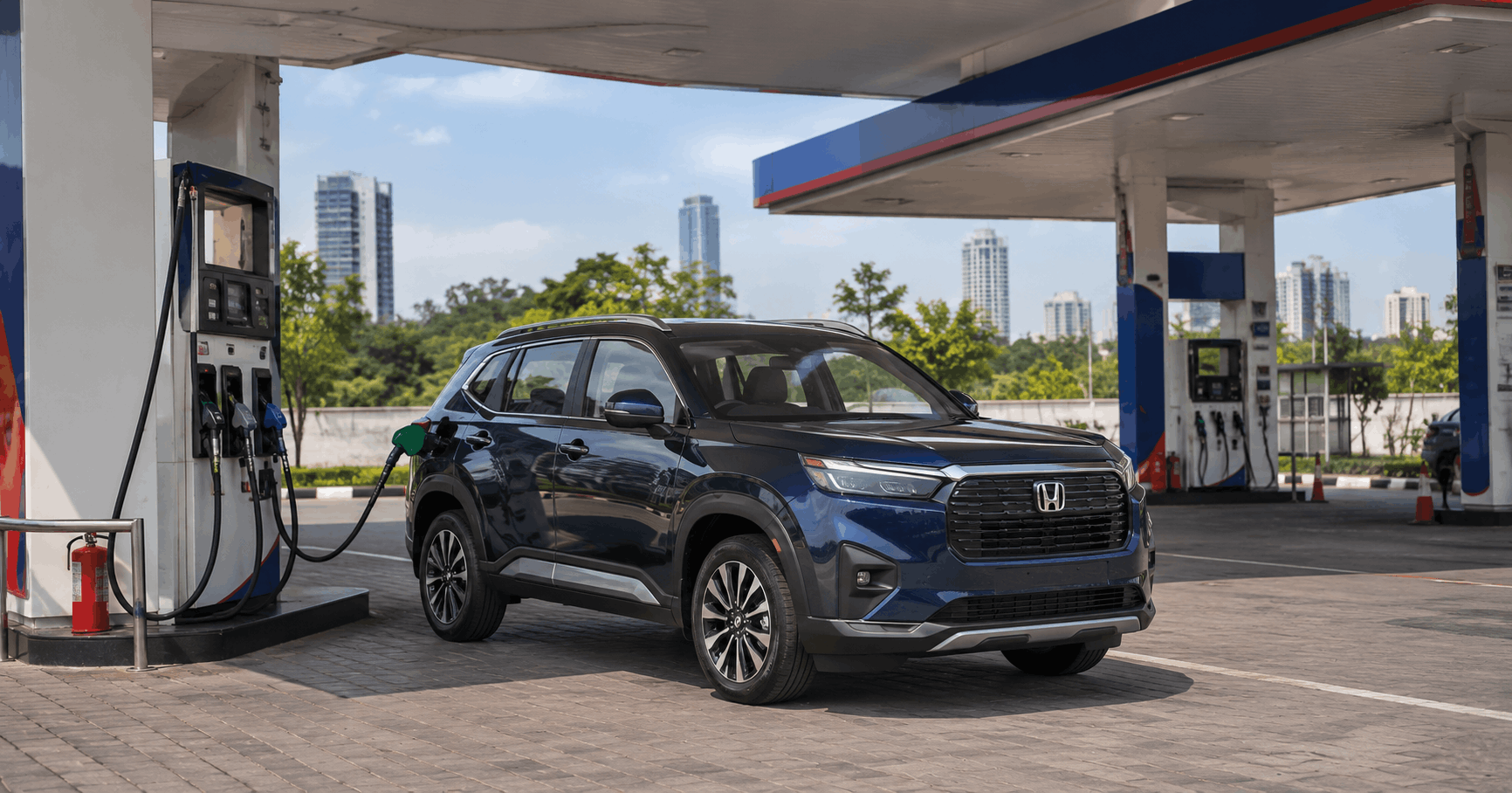
You pull into a petrol pump, and the board says the fuel is now E20. A small doubt creeps in. Is this okay for my Honda? Will it affect the engine? Should I be worried about the mileage or the warranty? If these questions have crossed your mind, you are not alone. With E20 petrol now the standard blend at most pumps across India, thousands of Honda owners are asking the exact same thing.
The good news is that checking whether your car can run on this fuel takes barely half a minute once you know where to look. This guide walks you through it in plain language, tells you which Honda models are covered, and clears up the confusion around the current e20 petrol price so you can drive without second-guessing every fill-up.
What Is E20 Fuel and Why Is It Important for Honda Car Owners to Know?
Let us start with the basics. E20 is petrol blended with 20% ethanol and 80% regular petrol. Ethanol is a plant-based alcohol made mostly from sugarcane and grain in India. The “E” stands for ethanol, and the number tells you the percentage in the mix. So E10 is 10% ethanol, and E20 is 20%.
India has been steadily raising the ethanol share in petrol for years. The idea is simple: home-grown ethanol cuts the country’s oil import bill, supports farmers, and reduces some tailpipe emissions. For you as a driver, the shift matters because ethanol behaves a little differently from pure petrol. It carries less energy per litre, and in older engines it can affect certain rubber and metal parts over time.
That is why e20 fuel has become such a common search. People want to know, in practical terms, whether the fuel going into their tank is a friend or a problem. For most Honda owners, the answer leans firmly towards friends, but it is worth understanding the “why” behind that.
How E20 Affects Mileage and Performance
Because ethanol packs slightly less energy than petrol, you might notice a small dip in fuel economy on E20, often in the low single digits as a percentage. It is usually minor and easy to miss in everyday city driving. Performance stays largely the same for cars designed to handle the blend. If you have suddenly lost a big chunk of mileage, the cause is more likely tyre pressure, a clogged filter, or driving habits than the fuel itself.
Which Honda Cars Are E20-Compatible?
Here is where Honda owners can relax a little. Honda has been building E20 material-compatible cars in India for well over a decade. In practice, this means the fuel system parts, seals, and lines in these cars are made to cope with a 20% ethanol blend without unusual wear.
The current Honda line-up is comfortably covered. That includes the City sedan, the Amaze, the Honda Elevate on-road price in Mumbai range, and the flagship ZR-V. Honda’s strong-hybrid models, such as the City e:HEV, are built for it too. If you are curious about the latest petrol-hybrid options, you can check the Honda City e:HEV on-road price and see how these cars are designed with newer fuel standards in mind.
The broader point behind searches like honda cars india e20 is reassurance, and it is well founded. The vast majority of Honda cars on Indian roads today can run on E20 as it is sold at the pump.
| Honda Model |
Body Type |
E20 Readiness (general guidance) |
| Honda City (recent generations) |
Sedan |
Designed for the current blend |
| Honda City e:HEV |
Hybrid Sedan |
Designed for the current blend |
| Honda Amaze |
Compact Sedan |
Designed for the current blend |
| Honda Elevate |
SUV |
Designed for the current blend |
| Honda ZR-V e:HEV |
Hybrid SUV |
Designed for the current blend |
Treat the table as a starting point, not the final word. Your car’s owner’s manual and fuel-flap label are always the most accurate source for your specific variant and year.
How Can You Check if Your Honda Car Is E20-Compatible?
This is the 30-second part. You do not need a mechanic or a workshop visit to get your answer. There are three quick places to look, and any one of them usually settles the question.
Check the Fuel Flap and Filler Cap
Open the fuel flap on the side of your car. Many newer models carry a small sticker or embossed marking near the filler neck that mentions the compatible fuel, such as “E20”. If you see it, you have your answer on the spot.
Look Inside the Owner’s Manual
Your owner’s manual has a fuel section that states the recommended petrol and ethanol blend for your exact model and year. This is the most reliable check because it is specific to your car rather than a general rule. Keep the manual in the glovebox and it becomes a 20-second reference.
Match Your Manufacturing Date
You can also check the manufacturing month and year printed on the plate inside the driver’s door frame. As a broad rule of thumb, Honda cars built in India from the start of 2009 onwards are made to be material-compatible with E20. Newer cars go a step further and are fully tuned for it.
When You Are Still Unsure
If the label is faded and you cannot find the manual, do not guess. A quick call to your Honda dealer with your VIN or registration number will confirm it in minutes. You can also raise it during your next service so it is noted on your record.
What Happens if You Use E20 Fuel in a Non-Compatible Honda Car?
Let us be balanced here, because scary headlines do the rounds. For a genuinely old, non-compatible engine, running E20 for a long time could, in theory, speed up wear on certain rubber and metal fuel-system parts and may cause a slightly rough idle or minor cold-start hesitation. Ethanol also attracts moisture, so a car that sits unused for long stretches is more exposed than one driven regularly.
Now the reality check. If your Honda is from the last several years, it is built for this fuel, so a tank of E20 is a non-event. The owners who need to be a little more thoughtful are those with very old vehicles or vintage models never designed for ethanol blends. Even then, the risk builds up over time rather than causing sudden damage from one fill-up. The sensible move is to confirm your compatibility using the checks above and then stop worrying.
When Did Honda Start Introducing E20-Compatible Cars in India?
Honda’s move towards ethanol-friendly cars is not new or rushed. The company has been producing E20 material-compatible vehicles in India for many years, with newer models progressively optimised as national fuel policy pushed the ethanol share higher. This long runway is exactly why most Honda owners today are already covered without having done anything special.
It also explains why the current rollout of E20 at pumps has been relatively smooth for Honda drivers. The cars were readied in advance, so the fuel simply caught up to what the engines were already built to handle. If you are shopping for a new car and want the latest fuel-ready models under one roof, it is worth visiting a Honda car showroom in Mumbai to see the current line-up in person.
A Quick Word on Fuel Prices
Many people who look up the e20 petrol price or the e20 petrol price today expect a separate, cheaper rate for the blend. In practice, E20 is largely sold as the standard petrol at the pump rather than as a special product with its own price board, and rates move with the usual daily fuel pricing in your city. So rather than hunting for a discount, focus on confirming compatibility, keeping your car serviced, and driving efficiently, which does more for your running costs than chasing a fuel-price gap that may not exist.
The Bottom Line for Honda Owners
Checking E20 compatibility really does take about 30 seconds: glance at the fuel flap, open the owner’s manual, or note your manufacturing date. For the overwhelming majority of Honda cars on Indian roads, the answer is a simple yes. Fill up, drive normally, and keep up with regular servicing. If you ever have a doubt about a specific model or an older car, your Honda dealer can confirm it quickly, and you can move on with complete peace of mind.
Frequently Asked Questions (FAQs)
Q.1 Does using E20 petrol void my Honda’s warranty?
A. For Honda cars certified to run on E20, using the blend as sold at the pump does not void your warranty. Always follow the fuel recommendation in your owner’s manual, and keep your service records up to date so your warranty terms stay protected.
Q.2 Is E20 petrol available at all fuel stations in India?
A. E20 has been rolled out widely and is now the common petrol blend at most stations across the country. Availability keeps expanding, so in most cities you will find it as the standard petrol rather than a special grade.
Q.3 Do I need to modify my Honda to use E20 fuel?
A. No. If your Honda is compatible with the blend, you do not need any modification, kit, or tuning. You simply refuel as usual. Only vehicles never designed for ethanol blends would need special consideration, and those are typically very old models.
Q.4 Can I mix E20 with regular petrol in the same tank?
A. Yes, for a compatible car it is fine to top up with whatever petrol grade is available, as the fuels are designed to work together. There is no need to drain your tank or wait for it to run empty before switching.
Q.5 Will E20 clean or damage my fuel injectors over time?
A. In a car built for the blend, E20 does not damage injectors under normal use and servicing. Sticking to your recommended service schedule keeps the fuel system healthy regardless of the ethanol percentage.